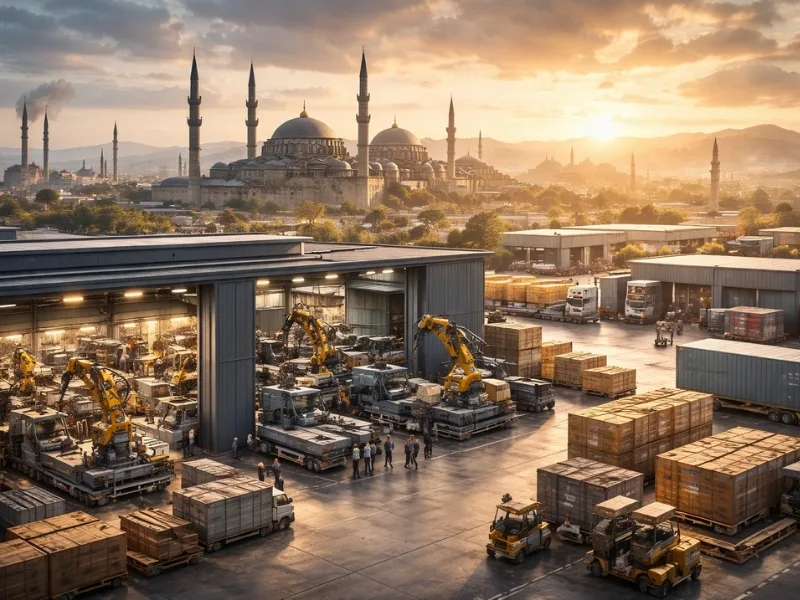
While Türkiye’s established industrial regions continue to maintain their production strength, cities across Anatolia have gained increasing momentum in recent years through rising investments and stronger export performance. Particularly in the machinery sector, organized industrial zones and export capacity demonstrate that Anatolian cities are no longer merely suppliers, but are becoming direct players in the global market.
At the core of this transformation lie a strong manufacturing culture, a flexible SME structure, and expanding export capability.
The Machinery Sector: Exports Exceeding 26 Billion Dollars
Türkiye’s machinery sector has shown steady growth in recent years. Total exports have surpassed 26 billion dollars, indicating that machinery production is no longer focused solely on the domestic market but has secured a clear position in global competition.
The sector is also among Türkiye’s leading exporters in terms of the number of destination countries. The European Union, the United States, the Middle East, and North Africa stand out as key export markets.
On the import side, dependency continues particularly in high-technology and specialized equipment segments. However, growing domestic production capacity has led to import substitution in certain areas, contributing to efforts to reduce the foreign trade deficit.
Anatolian Industry: From Subcontractor to Primary Manufacturer
Anatolian cities are no longer limited to contract manufacturing. Strong specialization has developed in high value-added machinery, spare parts, automation systems, and industrial equipment production.
Cities such as Konya, with a deep-rooted manufacturing tradition, have reached significant capacity in agricultural machinery, CNC machines, casting, hydraulic systems, and defense industry subcomponents. The expansion of organized industrial zones, strengthened logistics infrastructure, and rising export awareness have accelerated this transformation.
Today, manufacturers based in Anatolia:
- Export directly
- Participate in international B2B meetings
- Integrate into global supply chains
- Invest in brand development
This shift shows that production power is becoming more widely distributed rather than centralized.
The Structural Transformation of Exports
As Türkiye’s total exports approach the 250 billion dollar range, the machinery sector is increasing its share of this total. Growth in value-based exports and the rise in export value per kilogram are important indicators of qualitative transformation.
Anatolian companies now compete not only in terms of volume but also in technological sophistication. Automation integration, digital manufacturing systems, energy efficiency solutions, and smart machinery investments directly influence export performance.
The evolution of manufacturing power can be summarized in three key transitions:
- From low-cost production to value-added manufacturing
- From local markets to global markets
- From component production to system-level manufacturing
The Role of the B2B Ecosystem
Sustainable growth in international trade requires companies to connect with the right buyer profiles. For Anatolian manufacturers, B2B platforms and sector-specific trade fairs play a critical role.
Business meetings organized within the right platforms:
- Open new export markets
- Expand distributor networks
- Enable strategic partnerships
- Lead to long-term supply agreements
These contact points ensure that production grows not only in scale, but also through strategic positioning.
Toward 2027: Anatolia’s New Manufacturing Perspective
In the coming years, three main dynamics will shape Anatolian industry:
- Digitalization and smart manufacturing investments
- Energy efficiency and sustainability-focused production
- Localization in high-technology machinery production
As the quality of exports increases, Anatolia’s manufacturing strength will become even more visible. Regional industrial centers are becoming strategically important not only for Türkiye’s economy but also for global supply chains.
Conclusion
Anatolia’s manufacturing power is evolving from quantity to quality and from local to global. In the machinery sector, exports exceeding 26 billion dollars stand as a tangible indicator of this transformation.
In the coming years, Anatolian manufacturers are expected to strengthen their position further through technology investments, brand strategies, and international collaborations. The geographical distribution of production is changing, and competition is increasingly shaped not only by capacity, but by vision.
Anatolia is moving toward becoming not only a producer, but a driving force in the industrial landscape.